2,415 acres of productive farmland in Old Fields
A proposed MN8 industrial solar project would convert nearly 4 square miles of productive farmland — land currently zoned agricultural and residential — into industrial use for 30 to 50 years. This is a generational decision.
More about the proposed site
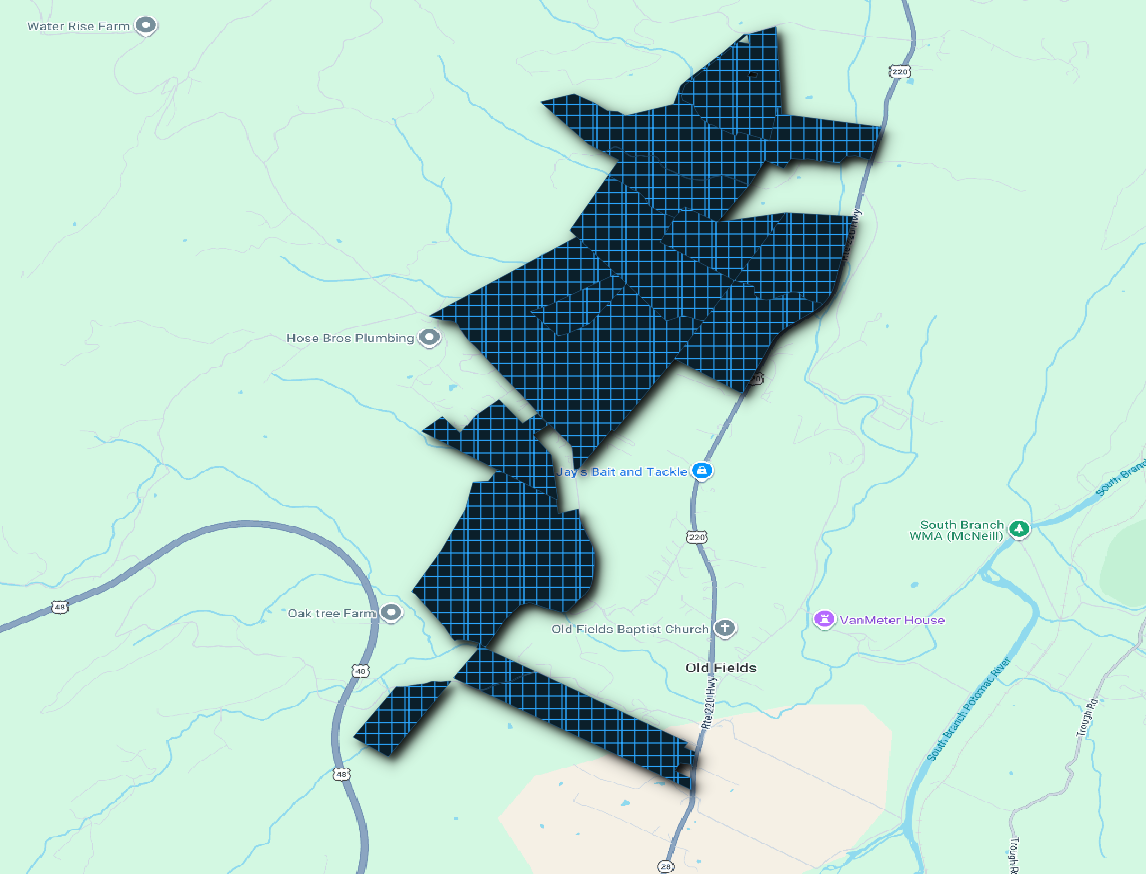
Precise location
The affected areas include:
- US Route 48 (Corridor H)
- Highway 220 North
- Fish Pond Road
- Webb Lane
- Becky Lane
- Old Fields Road
- JC Markwood Road
- Wright Farm Road
The proposed site sits in Old Fields, the heart of one of West Virginia's oldest and largest farm valleys. It contains the most productive farmland, in the largest concentration, anywhere in Hardy County. The 2,415 acres are not scattered parcels — they form a continuous block of working farmland and residential land, mostly zoned agricultural and residential (with about 500 acres zoned industrial). The site falls within Hardy County's designated "natural growth area," with access to public water and sewer — infrastructure that makes the land valuable for multiple community uses, not only solar.
How big is 2,415 acres?
Easier to picture than to grasp from the number alone:
Football Fields
1,830
Walmart Supercenters
625
Town of Wardensville
11.4×
Average Hardy Farms
9 farms
West Virginia's #1 agricultural county
Hardy County is not marginal land. It is the productive heart of West Virginia agriculture, with a tourism economy growing on top of it.
$269 million in annual ag sales — 28% of the state's entire ag economy
Hardy County leads West Virginia in agricultural production and sells $153 million more in agricultural products than the #2 county each year. We rank in the top 20% of all U.S. counties for agricultural production. This is not marginal land — it is the engine.
Hardy County By the Numbers
Source: USDA 2022 Census of Agriculture & Hardy County Planning
96% of our farms are family-owned
Hardy County has 500 farms, and 96% are family-run. 147 of those sell more than $100,000 a year — 35% more than any other West Virginia county. This is the backbone, not the margins.
Hardy County farmland averages $4,212 per acre
According to the USDA 2022 Census of Agriculture, the average value of farmland in Hardy County is $4,212 per acre. This is productive farmland — not acreage we can afford to convert.
Tourism brings $46.7 million a year — and it's growing fast
Visitor spending more than doubled, from $21.8 million in 2019 to $46.7 million in 2023. Tourism depends on the working rural landscape that this project would erase.
The county's own plan calls agriculture a top priority
The Hardy County Comprehensive Plan, adopted December 18, 2025, lists agriculture and farmland protection as a top community priority. It also instructs the county to weigh the costs of large-scale energy projects against existing economic drivers — agriculture and tourism — before changing zoning. This isn't just our argument. It's official county policy.
The math does not favor Hardy County
Strip away the marketing and look at the numbers. MN8 trades very little to the community for permanent use of our most productive farmland.
Nine permanent jobs for 2,415 acres
MN8 projects 300 temporary construction jobs and only 9 permanent positions for the entire project. That works out to 268 acres of farmland per permanent job. This is not investment. It is extraction.
Who is MN8 — and where do the profits go?
MN8 Energy was founded in 2017 as Goldman Sachs Renewable Power LLC and spun off in 2022. It is incorporated in Delaware and headquartered in New York, with additional offices in Boca Raton. Its key investors are Mercuria Energy Group (Switzerland) and Ridgewood Infrastructure (New York). The revenue from the Old Fields project would flow to Wall Street and overseas — not to Hardy County.
The PILOT payment is a fraction of what the land already produces
Instead of paying the property taxes a working farm pays, MN8 has offered Hardy County a Payment In Lieu Of Taxes (PILOT) of roughly $7 to $10 million spread over 20 years in exchange for converting the land to industrial solar. That works out to about $145 to $207 per acre per year — a flat fee that won't keep pace with inflation. Hardy County's farmland already generates many times that, and tourism brings $46.7 million annually on top. We are being asked to trade a real, growing local economy for a fixed payment that flows back to out-of-state investors.
The power leaves Hardy County — likely for Virginia
This is "merchant power" — wholesale electricity sold to the regional grid for out-of-state buyers. The most likely destination is Virginia's data center corridor, where new data center construction is driving record electricity demand. None of this power is reserved for Hardy County residents, and none of it will lower your bill. Your electricity is provided by Potomac Edison (FirstEnergy) under state-regulated rates — not by panels in Old Fields. The PILOT goes to the county general fund and schools, not to ratepayers.
Neighboring property values are on the line
An industrial solar facility does not stop at the lease line. Homes and farms bordering the project face the prospect of living alongside fencing, access roads, and panel arrays for 30 to 50 years. That kind of change is something prospective buyers notice, and it can weigh on the resale value and future use of neighboring properties — borne by landowners who never signed a lease and will see none of the PILOT payment.
If MN8 walks away, Hardy County pays
If MN8 abandons the project — through bankruptcy, sale, or restructuring — Hardy County and its residents are left to pay for cleanup. The Hardy County Planning Commission's own presentation on this project flagged exactly this risk: "Decommissioning and reclamation measures will not be carried out sufficiently — as has happened in the coal industry." Without a fully funded decommissioning bond posted up front, removing the panels, batteries, fences, and access roads becomes the taxpayers' problem.
This decision is effectively permanent
Developers promise the land can be returned to farming. The evidence says otherwise.
There is no proven path back to farming — anywhere in America
No utility-scale solar facility in the United States has yet completed decommissioning and returned to full agricultural production. When asked to provide a single example, MN8 has not replied. Soil compaction and infrastructure removal make restoration uncertain at best. Solar leases typically run 30 to 50 years — a generation or more.
West Virginians have heard "reclamation" promises before
The state Department of Environmental Protection is charged with bonding, decommissioning, and mitigation, and it has a long track record of inadequate bonds — thousands of acres across West Virginia remain unrestored decades after the coal industry left. We know how this story ends.
There is no shortage of appropriate land
West Virginia has hundreds of thousands of acres where industrial solar belongs — and the state already requires public utilities to use that land instead of farmland.
West Virginia has 573,000 acres of better land for this
173,000 acres of abandoned mine lands and 400,000 acres of identified degraded land sit available statewide. MN8 itself develops solar on reclaimed mine land in Kanawha and Mingo counties. They know how to site solar appropriately — they are choosing not to here.
State-utility solar must be sited on degraded land — by law
When Appalachian Power or Mon Power build renewable energy in West Virginia, the state requires those projects to be sited on degraded land. A private out-of-state developer should meet the same standard before being granted access to our most productive farmland.
Not all solar is the same
Understanding the difference between scales of solar is the difference between "we oppose industrial solar in Old Fields" and "we oppose solar." We don't oppose solar — we oppose this scale, on this kind of land.
Industrial / Utility-Scale Solar
Hundreds to thousands of acres built by private developers. Sells wholesale to the grid for out-of-state buyers. Long leases. Not designed to serve local residents.
~2,415 acres · MN8 proposal
Community-Scale Solar
Owned by a local cooperative or community group. Local subscribers share the energy and the savings. Smaller footprint, lower land-use impact.
1–30 acres typical
Rooftop / Private Solar
Installed on homes, businesses, barns, and parking lots. Owned by the property owner. Directly reduces that owner's electric bill. No land conversion.
No land conversion
Public Utility Renewable
Built by regulated public utilities like Appalachian Power and Mon Power. Required by West Virginia law to be sited on degraded land.
Required on degraded land
Real risks our community cannot absorb
Industrial solar at this scale brings industrial-scale risks. Two of them are specific and serious for Hardy County.
Battery fires would burn for days, and our fire departments aren't trained for them
Lithium-ion battery storage systems (BESS) can burn for hours or days, release toxic gases including hydrogen fluoride, and reignite after appearing extinguished. Our volunteer fire departments do not have the specialized training or equipment. MN8 has not said who pays for the emergency response, what the setback from homes will be, or who is liable if a fire spreads.
Stormwater runoff from nearly 1,000 acres of panels is a real concern
Per MN8's own coverage map, the project's facility footprint is approximately 993 acres of panels. Industrial solar sites elsewhere have triggered Clean Water Act violations for sediment runoff. Hardy County has working creeks, livestock water, and downstream neighbors — all of them sit in the path.
State preemption is the long-term threat
Right now Hardy County still controls its own zoning. That protection is under active threat from Charleston.
The legislature has already stripped local zoning over data centers
HB 2014 (2025) stripped local authority over data centers and microgrids. SB 242 (2022) exempted certain development from zoning. SB 171 (2024) stripped most County Commission powers over certain development. Solar may be next.
They've already tried to preempt solar — and they'll try again
HB 2459 (failed) would have made solar permitted in any zoning district. HB 3446 (failed) would have allowed the Public Service Commission to override local zoning entirely for renewable energy. Both may return.
What we can do to stop this damaging project
Utility-scale solar like MN8's is currently only allowed on industrially zoned land in Hardy County. The Planning Commission is drafting regulations to also allow it in Agricultural Districts — and many parcels in the Old Fields project would still need to be rezoned from residential to agricultural for the project to move forward. To stop this project, we are asking the Hardy County Commission and Planning Commission to keep current agricultural zoning protections in place.
Now what?
You've read the case. The decision is in Hardy County's hands — for now. Add your name to the petition, write to your officials, and show up to the next public meeting.